

Quantifying Reliability. Maximising Performance.
In today’s competitive industrial environment, downtime is expensive, redundancy is costly, and over-design wastes capital.
xSeriCon’s RAM (Reliability, Availability, Maintainability) studies provide a structured, data-driven approach to quantify system performance before issues occur.
We help organizations design smarter, operate more efficiently, and invest with confidence.
What is a RAM Study?
RAM (Reliability, Availability, Maintainability) Study is a detailed simulation of a process over its operating lifetime. It provides a prediction of the percentage availability (uptime) of the process, considering factors such as the process architecture, input and output variability, maintenance and operational philosophy, utility failure, and equipment failure rate.
Typically, a “base case” is analysed, consisting of a normal set of operating conditions. Variations are then introduced to study the impact of changes on the process availability.
Contact us to find out about our cost-effective RAM solutions.
Why should you apply RAM study?
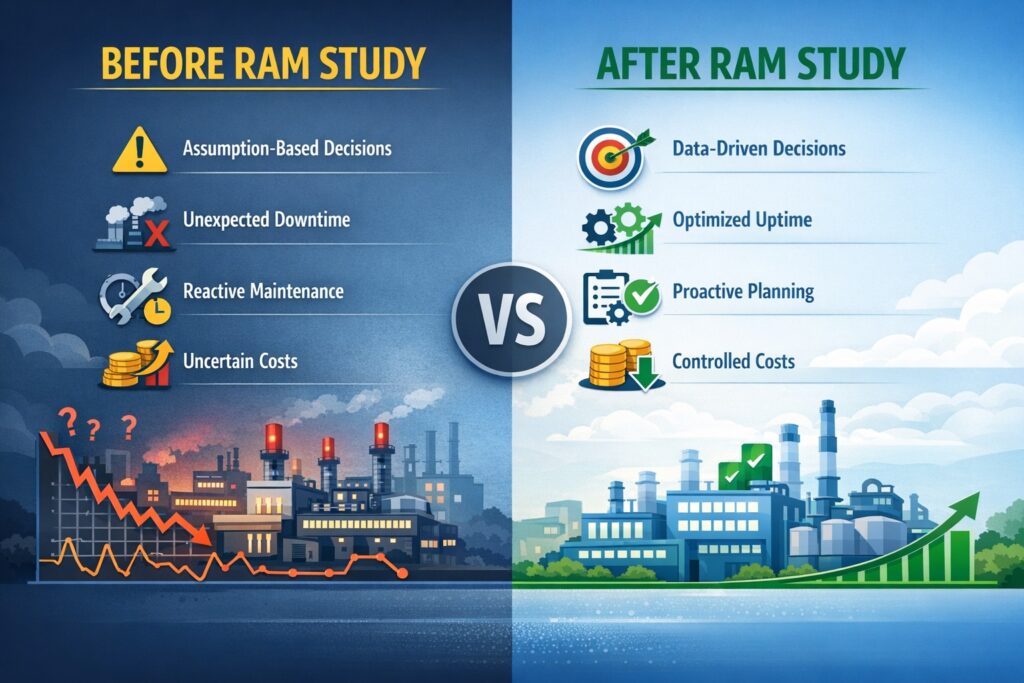
Before RAM Study
After RAM Study
Before RAM Study:
Decisions based on assumptions.
After RAM Study:
Decisions supported by quantitative reliability analysis.
Before RAM Study
| Aspect | Before RAM Study |
| System Understanding | Limited understanding of system reliability and bottlenecks |
| Design Decisions | Design based on assumptions or conservative estimates |
| Production Performance | Unexpected downtime and production losses |
| Maintenance Planning | Reactive or experience-based maintenance |
| Investment Decisions | Difficult to justify redundancy or equipment upgrades |
| Operational Risk | Higher risk of system failures affecting operations |
| Cost Efficiency | Higher lifecycle costs due to unplanned downtime |
| Confidence in Design | Uncertainty about whether the system will meet targets |
After RAM Study
| Aspect | After RAM Study |
| System Understanding | Clear insight into system reliability, critical equipment, and failure impacts |
| Design Decisions | Design supported by quantitative reliability modelling |
| Production Performance | Improved uptime and predictable production performance |
| Maintenance Planning | Optimized maintenance strategies based on reliability data |
| Investment Decisions | Data-driven decisions for redundancy, spares, and system improvements |
| Operational Risk | Reduced operational risk through identified weak points |
| Cost Efficiency | Lower lifecycle cost through optimized design and maintenance |
| Confidence in Design | Verified system availability and reliability performance |
The main objectives
- Evaluating the production uptime of the process
- Identifying areas of weakness which contribute the greatest to production downtime
- Identifying the criticality of all equipment in the facility
- Analyse the impact of proposed changes to the base case by performing sensitivity analyses
- Identify underlying causes of recurrent failures
The major benefits of performing a RAM study
- Optimise capital expenditure on redundant/spare equipment
- Optimise maintenance philosophy, including scheduling, manning and spares inventory
- Provide defensible predictions of system reliability, for use in budgeting and safety case
- Identify optimal equipment usage in facilities handling more than one process or feedstock
- Plan for failure scenarios
RAM Study develops a model defining the interdependence of resources, equipment and manpower, depicting this in a "Reliability Block Diagram (RBD)". This is used to simulate plant performance, providing a range of insights including:
Quantified System Availability
Bottleneck Identification
Redundancy Evaluation
Maintenance Optimisation
Spare Parts Planning
CAPEX & OPEX Decision Support
Almost every industries that has a processing system could benefit from a RAM study
Energy
Petrochemical
Manufacturing
Transportation
Food Production
Pharmaceutical
Semiconductor
- Many more…
Beyond Safety — Real Business Impact
• Performance Boost:
-
Reduce unplanned downtime
Identify reliability bottlenecks before they cause costly production interruptions.
-
Increase production efficiency
Optimize system performance to achieve more stable and predictable operations.
-
Strengthen asset reliability
Understand failure behavior and improve long-term system reliability.
• Financial Benefit:
-
Avoid overdesign
Prevent overspending on redundant equipment through data-driven design decisions.
-
Prevent costly underdesign
Ensure systems are sufficiently robust to meet performance and reliability targets.
-
Support investment justification
Provide quantitative analysis to justify design improvements and capital investments.
Availability is not a guess. It is a design decision.
Why choose xSeriCon?
Powered by xSeriCon’s proprietary RAM modelling platform, we deliver enhanced analytical depth and reporting clarity.
- Specialists in process and functional safety
- Real operational engineering experience
- Structured and defensible methodology
- Executive-ready reporting
- Integrated safety & reliability perspective
We connect reliability modelling with practical engineering and commercial realities.
Contact us to find out about our cost-effective RAM solutions.
Join Our Mailing List
Get first hand xSeriCon updates, articles, webinars and more!