
- Maximising the Value of Your HAZOP Investment
Getting More Value from Your HAZOP Investment
Among the many process safety studies undertaken during a major chemical or industrial project — including LOPA, QRA, FERA, EERA and others — HAZOP is often one of the most resource-intensive.
The cost extends far beyond consultancy fees. Consider the time spent by engineers, operators, project specialists and other stakeholders attending workshops, reviewing documentation, discussing scenarios and following up on recommendations. Add travel expenses and project delays, and the total investment can be substantial.
Yet HAZOP is much more than a regulatory requirement or a project milestone. When conducted effectively, it provides valuable insight into process hazards, design weaknesses and operational risks — while generating information that can support the safe operation of a facility throughout its lifecycle.
So how can you maximise the value of your HAZOP investment?
The answer isn’t just about having the right people in the room. The tools used to conduct, record and manage the study can make a significant difference to its efficiency, quality and long-term value.
1. Better Data. Better HAZOP Results.
Traditional spreadsheet-based HAZOP worksheets are familiar and widely used. However, complex studies often involve thousands of interconnected pieces of information — including equipment tags, process parameters, causes, consequences, safeguards, recommendations, assumptions and supporting documents.
Managing all this information in static spreadsheets can become increasingly difficult as the study grows.
A modern HAZOP software solution should do more than record findings. It should help connect the information, maintain traceability and make the study data easier to navigate, review and update.
Ideally, HAZOP data should be linked directly to relevant engineering information, such as equipment tags, design parameters and Piping and Instrumentation Diagrams (P&IDs).
These connections can help teams:
- Maintain data consistency as design information and process parameters change.
- Reduce manual data entry and the risk of transcription errors.
- Improve traceability between hazards, causes, consequences, safeguards and recommendations.
- Understand the rationale behind recommendations more easily.
- Preserve assumptions and supporting information for future reviews and revalidation.
When HAZOP data is properly connected and structured, it becomes a much more valuable engineering resource — not just a record of what was discussed during a workshop.
2. Make HAZOP Workshops More Efficient
A HAZOP workshop brings together people with different expertise, responsibilities and perspectives. Keeping everyone focused on the same scenario and relevant process information is essential.
The right software can help eliminate unnecessary administrative work and allow the team to concentrate on what matters most: identifying hazards, understanding risks and developing meaningful recommendations.
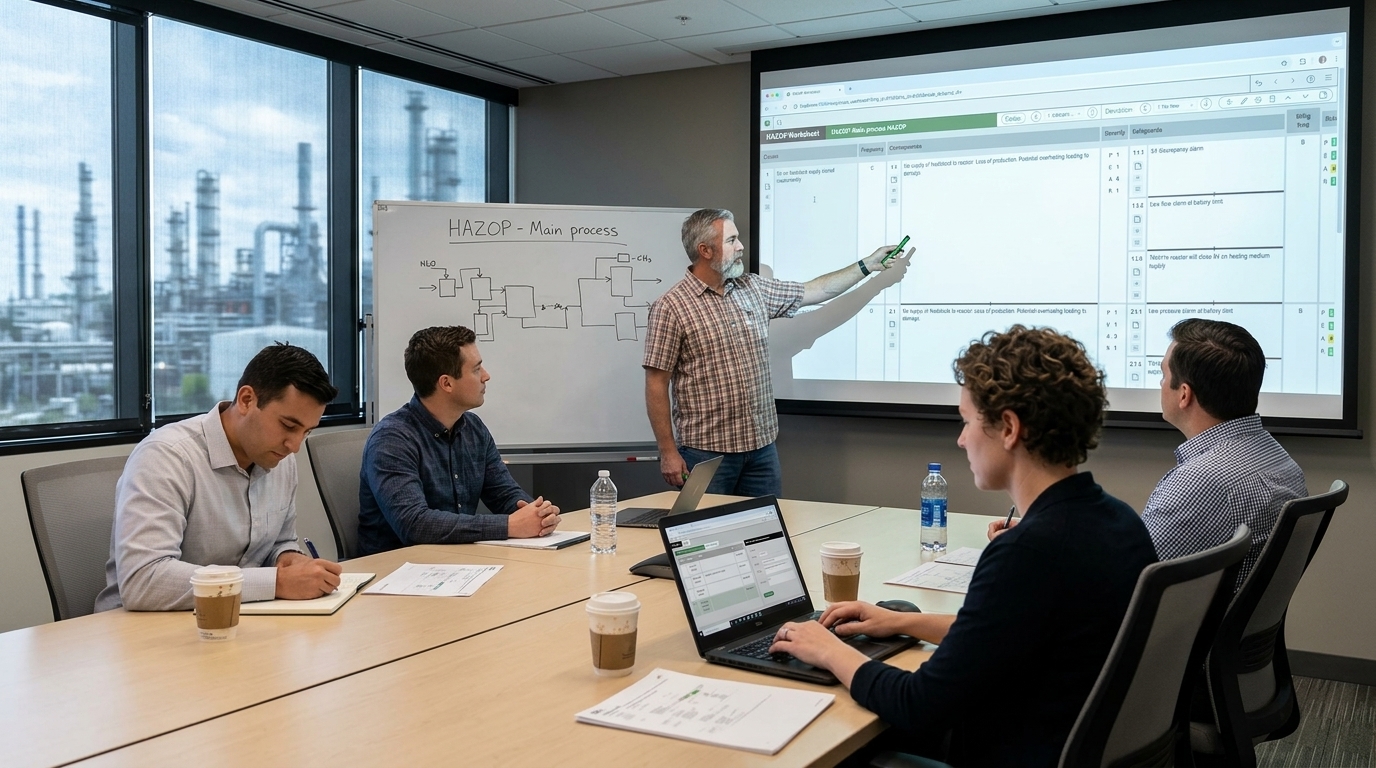
For example, displaying the relevant process equipment directly on a P&ID while reviewing a HAZOP scenario can help participants visualise the discussion and maintain context. Automatically retrieving equipment tags and descriptions avoids repeatedly entering the same information.
Other features that can make a significant difference include:
- Viewing HAZOP worksheets and P&IDs side by side.
- Navigating easily between nodes, scenarios, drawings and recommendations.
- Highlighting relevant equipment and process connections.
- Accessing related information without interrupting the workshop workflow.
- Supporting multiple screens for more effective collaboration.
Small improvements in workflow can add up to substantial time savings across a large study involving multiple nodes and extended workshop sessions.
Less time spent managing spreadsheets means more time spent on engineering discussions.
3. Your HAZOP Data Shouldn’t Be Trapped in One Application
HAZOP is often just one part of a broader process safety workflow.
The results may be used as inputs to LOPA, SIL assessment and verification, alarm rationalisation, Safety Requirements Specification development, or subsequent project and operational reviews.
Having to manually re-enter information between applications creates unnecessary work, introduces the potential for errors and makes maintaining consistency more difficult.
A software solution should therefore support effective data exchange with other tools used throughout the process safety lifecycle.
With practical import and export capabilities, HAZOP data can be transferred, reused and developed further as the project progresses.
Equally important is the ability to retain access to your own project data in readable formats.
Your engineering data belongs to you. A good software solution should make it easier to work with your data — not restrict what you can do with it.
4. How Vizop Helps You Get More from HAZOP
Vizop, xSeriCon’s online HAZOP and LOPA software, is designed to address these challenges.
By combining structured HAZOP data, interactive P&IDs, efficient workshop navigation and flexible data exchange, Vizop helps teams conduct studies more efficiently while maintaining the quality and traceability of their results.
Whether you are conducting a small study or managing a large, complex HAZOP involving multiple disciplines, Vizop provides tools to streamline the workflow, reduce administrative effort and make your study data more useful beyond the workshop itself.
The objective isn’t simply to complete a HAZOP faster.
It’s to get more value from the time, expertise and resources invested in every study.
Is Vizop Right for Your Project?
Choosing the right HAZOP software depends on your project requirements, existing workflows and the way your team manages process safety information.
At xSeriCon, we combine practical process safety consulting experience with software solutions designed around real engineering workflows.
If you would like to explore how Vizop could improve the efficiency of your HAZOP and LOPA studies, we would be happy to discuss your requirements and arrange a demonstration.
Discover how Vizop can help you get more from your HAZOP investment.
We Can Help
Designing and managing an SIS requires more than selecting a safety PLC.
It requires a clear understanding of process hazards, Safety Instrumented Functions, SIL requirements, system architecture and the complete functional safety lifecycle.
xSeriCon’s experienced functional safety specialists can support clients across this lifecycle, from LOPA and SIL assessment through SIL verification, Safety Requirements Specification (SRS), SIS design support and validation.
Our practical, client-focused approach helps ensure that your SIS is appropriately specified, efficiently designed and capable of meeting the safety requirements of your process.
Need help with your SIS or Functional Safety project?