
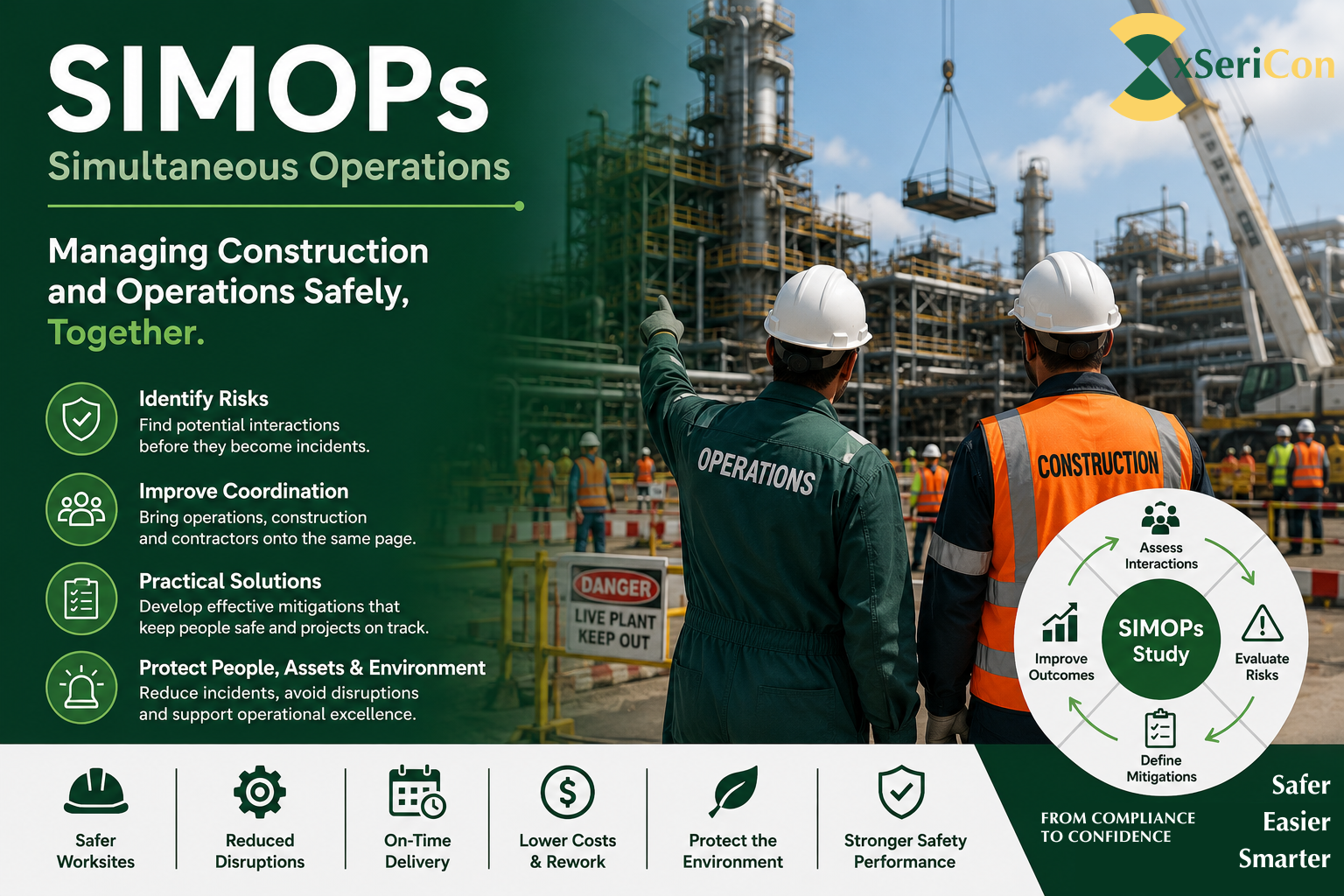
Avoiding “Them and Us”: Managing SIMOPs Safely
We know most industrial facilities tried their best to manage hazardous process operations safely.
Construction projects also have well-established safety procedures.
But what happens when both activities take place at the same time?
This is where many organizations face one of the most underestimated challenges in process safety: SIMOPs, 或 Simultaneous Operations.
Without proper planning, interactions between construction work and live process operations can create unexpected hazards, leading to production disruptions, schedule delays, environmental releases, or even major accidents.
Fortunately, these risks can be identified and managed before work begins.
What Is a SIMOPs Study?
A SIMOPs (Simultaneous Operations) study is a structured risk assessment that evaluates the hazards created when multiple activities occur simultaneously in the same location.
Typical examples include:
- Construction adjacent to an operating plant
- Plant expansion projects
- Brownfield modifications
- Shutdown and maintenance work
- Commissioning new equipment alongside operating units
- Decommissioning obsolete facilities
The objective is simple:
Identify where different activities may interfere with one another and implement controls before those interactions become incidents.
Either way, most process engineers, operations personnel, and HAZOP facilitators will encounter a revalidation exercise at some point in their careers.
The question is: how should it be approached?
The SIMOPs Matrix Is Only Part of the Story
Search online for “SIMOPs” and you’ll probably find a colourful matrix.
Construction activities are listed along both axes, with coloured boxes indicating whether two activities can proceed together:
- 🟢 Green – Can proceed together
- 🟡 Yellow – Can proceed with additional controls
- 🔴 Red – Activities should not occur simultaneously
These matrices are useful, but they only consider interactions between construction activities.
The more significant risks often arise when construction work interacts with operating process facilities.
This is where a traditional activity matrix reaches its limits.
Looking Beyond Construction Activities
At xSeriCon, we prefer to approach SIMOPs using a structured HAZID-style workshop.
Rather than simply comparing activities, the team systematically reviews how construction and operating facilities may affect one another.
Typical discussion topics include:
Access and Space
Could construction laydown areas block emergency escape routes, maintenance access, or operational work areas?
For offshore projects, similar conflicts may occur within marine or water access zones.
Utilities
Will construction overload, interrupt, contaminate, or isolate shared utilities such as:
- Electrical power
- Instrument air
- Cooling water
- Steam
- Nitrogen
- Communications
Shared Personnel Facilities
If contractors and operating personnel share welfare facilities, parking, control rooms, or access routes, are these facilities adequate?
Are responsibilities clearly defined?
Contractor Coordination
Do contractors understand ongoing plant operations?
Likewise, do operations personnel understand construction activities taking place nearby?
Poor communication between separate work groups remains one of the most common causes of SIMOP-related incidents.
Vehicle Movement
Construction traffic introduces additional hazards including:
- Congestion
- Pedestrian interactions
- Restricted visibility
- Noise
- Vibration
- Collision risks
These impacts can extend well beyond the construction area.
Material Storage and Waste
Temporary storage areas can create unexpected fire, explosion, environmental, or access hazards.
Waste handling should also be considered alongside normal plant operations.
Tie-ins and Live Connections
Connecting new systems into existing piping, electrical systems, utilities, or control systems often represents one of the highest-risk phases of a project.
Every tie-in should be carefully planned, reviewed, and controlled.
Decommissioning Existing Equipment
Removing obsolete equipment can introduce hazards that receive surprisingly little attention.
Residual hydrocarbons, trapped pressure, temporary isolation arrangements, and dismantling activities all require careful planning.
Working Environment
Construction activities can affect plant operations through:
- Dust
- Noise
- Vibration
- Reduced visibility
- Communication difficulties
These seemingly minor issues can significantly increase operational risk.
Emergency Response
Finally, emergency planning must consider both construction and operations personnel.
Questions include:
Have emergency response procedures been updated to reflect current site activities?
Are evacuation routes still accessible?
Can emergency services support both workforces?
Is emergency communication coordinated?
The Goal Is Collaboration—Not “Them and Us”
Perhaps the greatest benefit of a SIMOPs study isn’t the checklist itself.
It’s bringing operations personnel, construction teams, contractors, maintenance staff, and project engineers together before work starts.
Many incidents occur because each group manages its own activities safely—but nobody fully understands how those activities affect everyone else.
Successful SIMOPs management replaces “them and us” with one coordinated team working toward the same objective.
Because when process operations and construction must coexist, effective communication becomes one of the most important safeguards on site.
Need support with a SIMOPs study? 👉 Contact xSeriCon today
At xSeriCon, we facilitate structured SIMOPs workshops using a HAZID-based methodology that helps identify operational conflicts, assess risk, and develop practical mitigation measures before work begins.
Looking for a time-saving tool for your HAZOP workshop? Check out Vizop! A modern 瀏覽器型流程危害分析 (PHA) 軟體 designed for better HAZOP, Alarm Management, LOPA, and more.